A scriptable future for the Web and home servers

I’m organizing papers today, and I keep finding dev-notes and plans for my big “home server” idea about being able to run all your “cloud services” on your own hardware with all the data protection this entails. But what is easy to imagine can be difficult to bring to reality. There are a lot of technological aspects to figure out (dyndns, mail, www, filesharing, apps?), but there is also the lack of interest in privacy matters of the general public.

The freedom of computing and the Internet is a question that depends on technology but also on public relations. I recently came up with a plan for one possible way to get FOSS into homes. PR is indicated in brackets.

  • Phase 0: Develop FOSS clones for most popular cloud software. [100% done]
  • Phase 1: Non-tech-savvy users learn to deploy “own server” in the cloud based on a FOSS software stack. [2015]
    (Run your own Google with just one click! Customize and automate everything. Don’t let anyone tell you what to do on the Internet.)
  • Phase 2: Non-tech-savvy users move their existing “own servers” to run on their “home server.” [2020]
    (The Internet is distributed; be the Internet. Who got ur logs? Protect your privacy and that of your family and friends. Political discussion is not a crime. Unlimited storage—just add USB drives to the RAID. )

I think the two-step process for the home server is much more likely, even realistic. Both phases involve transitions to better features. The transition to Phase 1 will be interesting for power users, but if everything is scripted, then even non-tech users could “run their own” thing. For it to happen, we need to get to “same thing as … but with more ….”  Only after we have a mature system of own apps can we then move to Phase 2 where we say: “same thing as own, but at home.”

I’m a big believer in humanity and our ability to learn adapt and advance so I think we will be able to “domesticate” the power of computing as we previously domesticated fire and electricity.

Linear algebra tutorial in four pages

I just pushed an update to the Linear algebra explained in four pages tutorial.

Linear algebra tutorial in four pages thumbnail

Anyone who has an exam with lots of $A\vec{x}=\vec{b}$ stuff on it coming up should check it out because it covers: vector operations, matrix operations, linear transformations(matrix-vector product, fundamental vector spaces, matrix representation), solving systems of linear equations (the RREF stuff), matrix inverse, eigenvalues.

UPDATE: I found another excellent tutorial which I think you should also read, especially if you are a visual person. A Geometric Review of Linear Algebra by Prof. Eero P. Simoncelli  (discuss on HN if you are a procrastinating person). If you’re a studious person, you’ll also go to en.wikibooks.org/wiki/Linear_Algebra and practice solving problems. To become a powerful person, don’t look at the solution until you’ve attempted the problem (with pen and paper) for at least five minutes.

UPDATE: I found some other useful short tutorials, like this short review of linear algebra from Stanford and another one from Boulder which both cover interesting details and bring a new perspective.

Open book writing and typo workflow

Open is better than closed because when you work in the open the whole world can help you (or at least the portion of the world that cares about what you are doing). For books in particular, readers can be tremendously helpful by submitting typo fixes to the book. But how can users submit typos? Surely there is something better than email…

Today I saw a very interesting workflow for reader contributions on the Advanced R programming book website by Hadley Wickham. The book  is being developed on github using the Jekyll static site generator. Each page has an “Edit this” link on the right side:


The url for that button is:

https://github.com/hadley/adv-r/edit/master/index.rmd

Clicking on that takes you to github and a special prompt to create a fork:

Next you can make the change:


And finally the UI offers you to do a pull request:

This is still a complicated process for the reader (3-steps, one feature branch, one pull request), but from the author side this is awesome! You just write and then manage incoming pull requests that improve your content.

Anyone writing their blog posts in the open on github should consider adding the /edit/ links.


Weekend project: find a way to automate this workflow process so readers don’t need to have github accounts. Maybe I could create a “shared” github account “ivans-readers,” allow for login-less-editing to happen on my own server and then see the pull requests coming from ivans-readers on the main repo.

One day of advertising on facebook

Early this morning, my facebook advertisement campaign of the wall post containing the word “bullshit” was approved and went live.  A total of 8684  people were shown the post in their news feed thanks to this “Page Post Engagement” campaign.

Metrics: The measurable results of 8.6k impressions are 44 Website Clicks (mostly the link to gumroad), 33 Post Likes, and 23 Page Likes. Over at the analytics panel at gumroad I see 7 visits from m.facebook.com and 23 visits from facebook.com.

Conversions:  Perhaps most importantly, none of these visits converted to any sales. 🙁   Though to be realistic, perhaps I’m expecting some of these visits to convert tomorrow or after tomorrow. I’m imagining the visitors downloaded the preview PDF and will check it tonight and tomorrow and those that like what they see will come back to purchase.

I’m thinking now the ad copy wasn’t the best. Perhaps students who read the post are not ready to be sold to yet and I’m sending them to gumroad too soon… I should probably make a proper landing page with the “get this book, read it, ace the finals” pitch front and center.

I was very optimistic about this campaign because I chose my target audience to be “college students graduating in 2017” which means they are in first year right now, which is exactly my target audience.

Costs analysis  The total cost of this campaign for today was $25. I would have to make 1.25 sales/day to break even with this approach, which, with some ad copy tweaking, should be possible. At least I got lots of likes on my page now. I still can’t get over how funny (or sad?) it is that I’m paying to be liked. Here is modernity for you: you pay to be liked.

The not-so-successful launch of v4.0

I recently announced the launch of the fourth edition of the book on hacker news. This re-launch was significantly less successful than the initial launch from January 1st. I’m a little disappointed from the whole experience, but I think there are lessons to be learned here.

Was it bad timing?  I worked until late the previous night to update the website copy, but I left some things for this morning, which meant I was only able to post at 11:30AM. The “best practices” suggest 9AM–11AM EST, so I was a little out of that range.

Should-I have chosen a better title? I went with the “No bullshit guide to math and physics, v4.0” since this is basically what I was announcing. Should I have mentioned the 34% off deal on the eBook?

The interesting take away for me is that, while extremely useful, hacker news cannot be my main channel for promoting the book. I need to come-up with a repeatable and scalable strategy for attracting members of my three target audiences to the webpage. I’m now playing with google AdWords and Facebook advertisements. Let’s see if spending some money will lead to a good return on investment.

I also posted the /launch40 URL to several channels on reddit where it was very poorly received. The redditors protested the advertisement-like nature of the post. I see their point. Though, honestly, I think my book could be genuinely useful to the students at McGill and UofT. Exam season is coming after all, and I know some students could use some help! The next time I post to HN/reddit, I post the updated mechanics tutorial: useful, educational, and fun, but ending in a little advert for the book.

Pricing

I recently read an article about pricing which showed some interesting data from various gumroad products. The stats seemed to show that classical “trick prices” ending in 9, like 19, 29, or 39 have nearly double the conversion rates of the corresponding round prices like 20, 30, and 40. This got me thinking: maybe it would be a better idea to change back the price of the No bullshit guide to math and physics to \$29 as it was before.

But let’s not just guess. Let’s look at some data. I implemented the new price (\$33) on August 3rd. Let’s compare the sales/visits stats for the book between two-months-long periods before and after the price change.

At \$29     Jun 3rd — Aug 2nd

During this period there were 1402 visitors to the website, of which 45 clicked through to the gumroad page and 9 clicked through to the lulu store page.  Meanwhile,  gumroad reports 161 visits and 14 sales for that period. On lulu, there are only 2 sales.

At \$33     Aug 4th — Oct 4th

During 2 months period with the new price, there were 1734 visitors to the website, of whom 79 clicked through to gumroad, and 77 clicked through to lulu. Just looking at these numbers makes me think the comparison is not fair: after all this period includes September which is the peak demand time for calculus and mechanics. During this period, there were 208 views on gumroad and 12 sales.  On lulu, there were 13 sales.

Okay, what can we conclude from all of this? I’d say not much, given the small numbers. Still I find the conversion rate gumroad@29: 14/161=8.6%  and gumroad@33:  12/208=5.7% was affected. Indeed \$33 sounds like quite a bit for an eBook no? But \$29 sounds OK. Maybe I should make the eBook \$19?

Okay. So I think for the launch of 4.0, I will switch back to \$29. As for the eBook price, I will have to think about it some more.

October launch

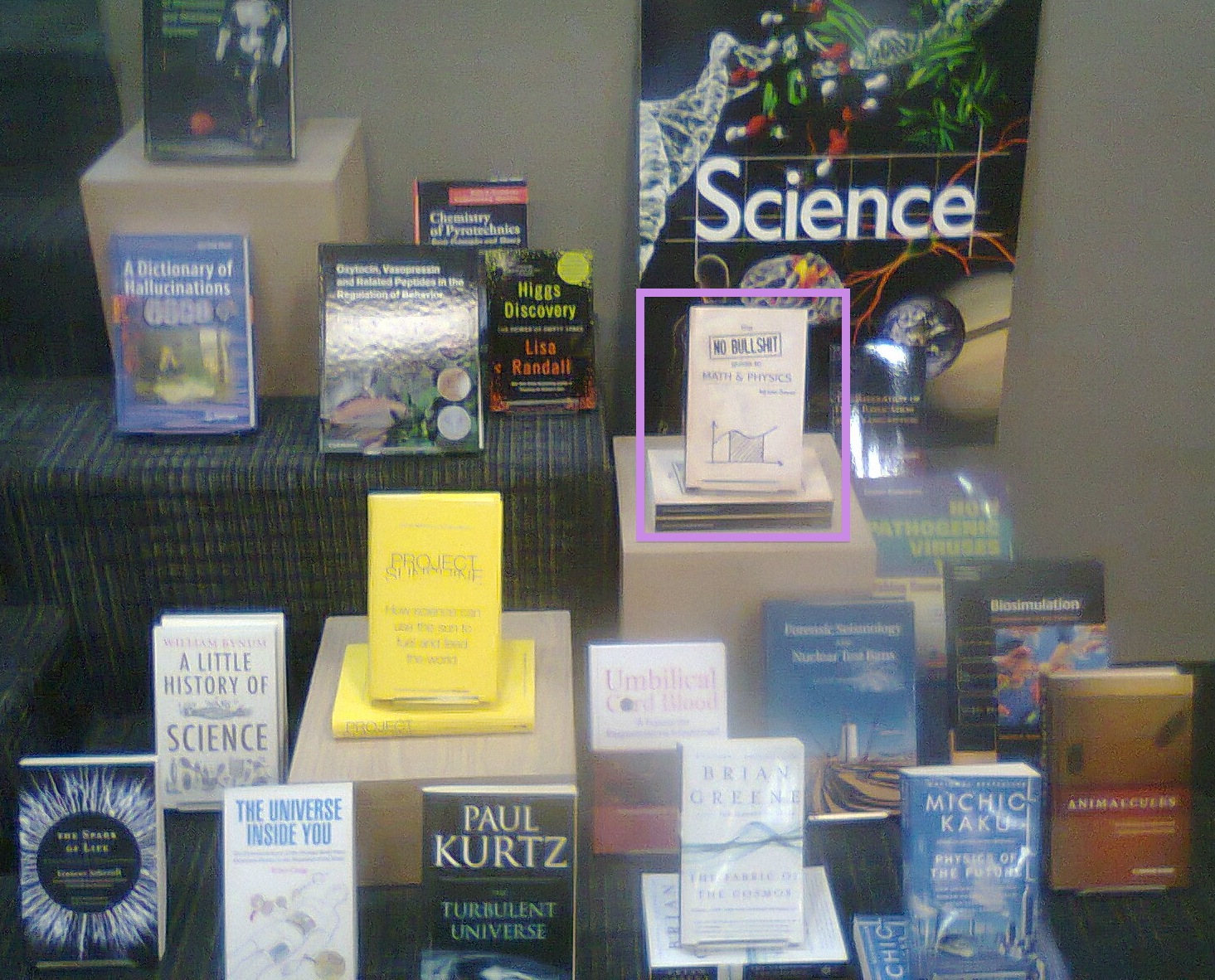
The No bullshit guide to math and physics is now available for sale at the McGill bookstore and the Concordia bookstore. This is another milestone which I am really happy about. Yesterday I went to check it out and was very happy to see the book in a special display for science books.

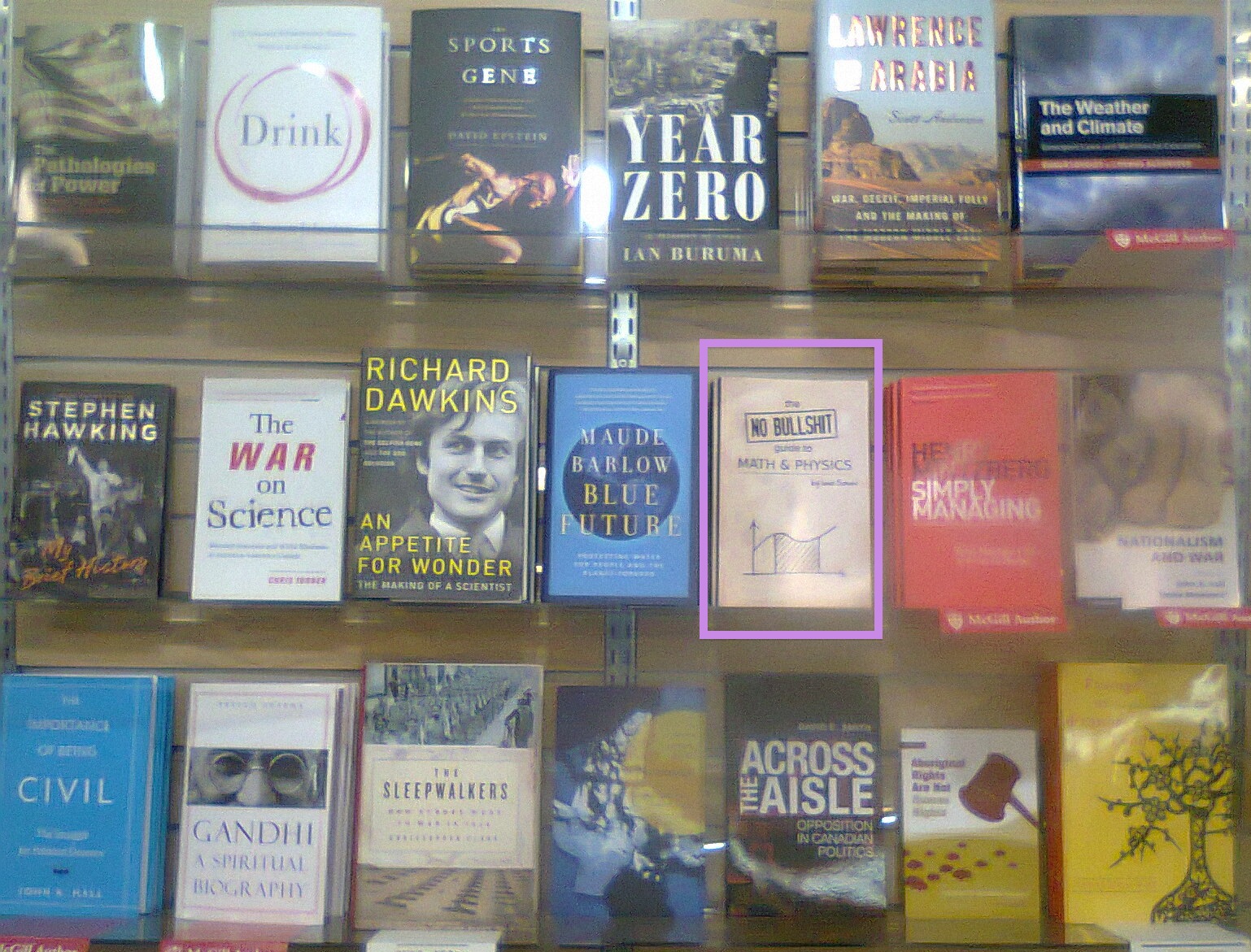
The book was also on display in the new releases section.


Kind of cool to appear next to Richard Dawkins.  Okay, one bookstore today, five more this month, continent-wide by the end of the year and eventually take over the world!

Linear algebra flyer

This evening I finally figured out a plan of attack for developing the Linear Algebra title.

  1. I will prepare a flyer which covers all the material.
  2. Distribute the flyer T & R 08:35AM-10:55AM MDHAR G-10 to the 88 registered in the class.
  3. The flyer will say “free eBook” and link to noBSgui.de/to/LA
  4. On the side I will ask them to sign up to the LA mailing list and then send them a free PDF of the ebook.
  5. Ask for feedback by email after the final is done

I already have setup a an LA help desk, so I will advertise that too.

Okay, better get on this ASAP, because tomorrow is very near.

Discipline

I just received a letter from IEEE transactions on info theory with reviewers comments on one of our papers. Tonight though, what is left of it, is dedicated to work on the Mathematics Fundamentals chapter. You have to do what you have to do. I have downloaded all attachments but they can wait until tomorrow PM. Discipline.